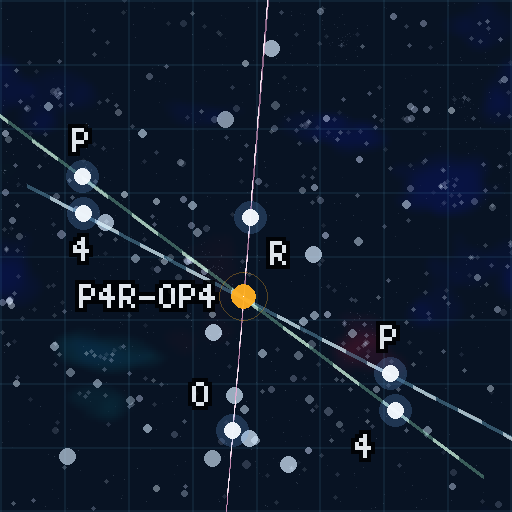
Stargates with missing images have learned to draw their own little maps.
The network can now remember favourite destinations, share better searches, and make browse pages less eager to load the entire galaxy at once.
Points of Origin are less ticket-shaped now.
The replicators found some exciting pressure points in the website.
The address system received a correlative update.
Stargates
Starmaps
Public Stargate listings now have more visual variety. If an owner has not uploaded a custom image, the site shows a generated starmap instead of another identical placeholder.
These fallback starmaps are coordinate-style images derived from the Stargate's address information, which is based on the actual in-world location of the gate. They are deterministic, so the same usable Stargate address produces the same visual layout. Owner-supplied images still take priority; starmaps are a fallback, not a replacement.
Forced dials and Stargate API states
We fixed Stargate API calls so "forced wormhole" now handles outgoing and open statuses in a way accessories can track gracefully.
Forced wormhole dials skip part of the normal dialling sequence, so the in-world Stargate does not need to animate each chevron lighting up. Third-party scripts still need those skipped states, though. After Vala Avro noticed that accessories were getting confused, we now send all relevant API calls rapidly so they can follow the state changes correctly.
Default dialling button events
The default dialling button, normally "ASN Hub" in the dialogue menu, now has proper event handling. For events such as last month's Sci-Fi Con, we can now swap that button for another destination on a schedule.
Better public dial messages
Public dialling messages now include the destination region's visit type and maturity rating. Instead of only seeing a destination name, travellers can also see whether the destination is casual, roleplay-focused, or otherwise described by its current visit type, alongside the region's maturity rating. A little more context before stepping through the event horizon.
Address recalculation and SGC-IDs
We adjusted Stargate address calculation after the starmap work revealed that some SGC-IDs were becoming seven characters long.
In the show, SGC-IDs were only ever six characters. Milky Way addresses began with P, and Pegasus addresses began with M, leaving only five characters to generate a unique address. Unlike the regular six-character address scheme, those characters can repeat. The Second Life grid turned out to be larger than the older calculation expected, so some generated values were pushing beyond the intended, more canon-friendly shape.
The algorithm has been adjusted, and the network has undergone automatic correlative updates to compensate for interstellar drift, universal expansion, and updated stellar positioning data. Some gate addresses may therefore have shifted slightly.
Or, less lore-friendly; Second Life grid is big, maths is rude.
Fav
ASN now has a favourite system called Fav (which avoids me having to choose between American or British spelling). It uses heart and broken-heart symbols on the website and in-world; it replaces the old voting/rank system, which was not very flexible or well used.
On the website, logged-in users can save Stargates to a personal Fav list, remove them later, and use the list as a private shortlist. Public pages can show aggregate Fav counts, but saving a gate does not automatically expose who saved it.
In-world, registered users can Fav or unfav the current gate from the Stargate menu. Unregistered users who click the Fav buttons are offered account creation from that flow and can immediately add the target gate to their favs.
You can random dial your own favs with fav, for example /d fav.
If you make your favs public, you can share them for others to view. Public fav lists can also be dialled, for example /d fav ash qin. Dialling through a fav list ignores whether the target Stargate has random enabled or disabled, which may be more appropriate in some roleplay settings.
Stargate Teleport Access Checker
Random dial has often led travellers into no-access land, security orb ejections, missing Stargates, or other confusing arrivals, which understandably discourages random dial use.
To address this, we implemented StargateTeleportAccessChecker, a dedicated Second Life bot that visits eligible random-list Stargates and checks the practical arrival experience. It asks one simple question:
Can an ordinary traveller arrive, find the Stargate, and use the destination without being blocked, ejected, redirected, or left somewhere confusing?
This gives us repeatable live-grid evidence instead of relying only on self-reporting, manual spot checks, or someone eventually reporting that a random destination was not very random-friendly after all.
For gate owners, the useful part is guidance. If a random-listed gate fails a public-access check, clicking the Stargate or visiting the edit page can explain what appears wrong, helping owners fix access, landing-point, placement, or security issues they may not notice because they usually have elevated permissions.
This also ties into the Stargate Standards of Placement. Public random Stargates should be visible from the telehub or primary arrival point and no more than 40 meters away; a random traveller should not arrive in a region and have to begin an archaeological expedition just to find the gate. Roleplay destinations get some leniency when they use the Roleplay Visit Style in taxonomy, because unusual arrivals can make sense, but the network still needs to know the oddness is intentional rather than accidental.
The bot is not a punishment system, and it does not replace support reports or administrator judgement. Temporary Second Life issues should not immediately mark a good gate as bad, and a failed check does not mean the owner has done anything malicious.
View and edit page cleanup
ASN view and edit pages have been tidied up. They now include taxonomy information, and several pieces of information have been rearranged and resorted so the pages are easier to scan. These pages have accumulated a lot of responsibility over the years, and we want them to feel less like a drawer full of tangled cables.
The ASN view page now also uses buttons instead of links for various Stargate actions, preventing issues where some browsers prefetch links and accidentally trigger actions.
Shareable database searches and browse sorting
Searches on ASN database now create shareable links, so filtered database views can be sent to someone else, bookmarked, or returned to later instead of being trapped in the current browser session.
We also added many ASN database sorting options to ASN Browse, giving the more visual browsing page more of the database view's practical search behaviour.
Points of Origin
Milky Way Stargates now have a new backend for the Point of Origin system.
Previously, setting a custom Point of Origin could require a support ticket, even when the user owned or was allowed to use that origin. Users can now assign available Points of Origin they own directly from the Stargate edit page.
Reserved Points of Origin are also clearer. They now display with a red outline, meaning "reserved". It does not mean the origin is broken, or that we are judging your symbol choices.
Magic single-use Settings links
The ASN 1.1.3 settings button menu has been replaced with a magic single-use login link. Taxonomy was pushing the Settings dialogue into menu-maze territory, so authorised owners or controllers who use the in-world Settings action now receive a time-limited, single-use link from Alpha-Fox through the VI instant messaging system ℹ️.
Opening the link takes the user directly to the Stargate edit page after the usual checks pass. The link is consumed when used, expires if left alone too long, and still must pass normal owner or administrator permission checks before the edit page is useful.
If the same website user is already signed in, the link can take them to the correct edit page without starting a second session. If it creates a new session, that session is marked as a Stargate Settings Link login rather than an ordinary password login.
This is smoother than navigating a menu maze and keeps the login link out of Stargate-visible output. The link is still a credential until used or expired, so it should not be shared.
Missing Settings link controls
After the Settings link flow went live, Bleizdu Irelund correctly identified that the linked page lacked controls people expected from the old experience.
Those controls have now been added to the edit page, not just the view page, along with other improvements to make the flow clearer. The link now lands people somewhere that behaves more like the normal edit experience.
Website-specific changes
IP reference links
We added IPInfo and AbuseIPDB links for IP addresses on the session page.
These are services that can give details on IP addresses, which should make it easier when reviewing unfamiliar account activity; quick access to network ownership, approximate location context, and abuse-report information is useful.
The session page should now give residents more practical information when deciding whether a session looks familiar or should be signed out.
Fewer unnecessary sessions
Website session handling has been rebuilt so anonymous read-only traffic no longer creates unnecessary session files. Crawlers, bots, and enthusiastic automated systems should be served as public reads, not treated like millions of new people logging in and filling storage with pointless session state.
The authenticated side changed too. Sessions now have a stricter idea of where they live and how a browser proves it is asking for the right account's session, including the cookie ℹ️ state it sends back, rather than treating every old flat session file as equally trustworthy.
Authenticated sessions now carry clearer information about how they were created. The session page can show whether a user logged in through the website, used "remember me", or came in through a Stargate settings link. Older or incomplete sessions can still fall back safely when that information is unavailable.
The session display now shows full country names instead of only country codes, and can indicate when a session appears to be using a TOR exit node ℹ️.
Faster lookups under pressure
We improved website SQL ℹ️ query lookups to make pages faster and more efficient, especially under extreme replicator (crawler) traffic.
At around 10,000 requests per second, tiny inefficiencies stop being tiny. Repeated lookups, unnecessary session creation, and page paths that are fine under normal human use can become very loud under automated traffic.
The query work focused on making commonly hit pages cheaper to serve and less likely to repeat database work. When a page needs the same supporting account, origin, taxonomy, or display information for a set of Stargate cards, it should prepare that context deliberately instead of rediscovering the same facts over and over while drawing the page.
Lazy image loading
Images on /asn/db/ and /asn/browse/ now use lazy loading ℹ️.
Those pages can render many Stargate cards, each with a gate image, generated starmap, possible Point of Origin, and address glyphs. Loading every off-screen image immediately can be intense for browsers, especially on long result pages, so the browser can now defer images until they are needed.
Updated about page
We have updated our about page, which covers our current staff; I'm really digging the new staff photos.
Prim Network
For the longest time, we've used Flickr as a location for users to post fun pictures; however, over time, Flickr has somewhat reduced in popularity, probably in part due to the restrictions they added to free users. So we've decided to move away from Flickr and start using Prim Network, which is a more Second Life-focused sharing platform.
Some of the big advantages of Prim Network include:
The staff are friendly and open.
Prim Network supports group posting and group feeds, similar to Flickr.
Serves diverse/niche communities without the visibility issues of larger social networks, where mainstream content drowns out everything else.
Supports navigating destinations on their website by Stargate!
If you're on Prim Network, we'd love it if you joined us!
We have replaced the old Flickr page with a new page showing the recent photo posts from Prim Network.
Backend things
POST actions now redirect cleanly
This is one of the subjects that I am going to struggle explaining in layman's terms, so the short of it is that it stops the issue where refreshing a page makes the browser ask whether you want to submit the same form again.
The more technical side is that much of the functionality that triggered POST requests will now redirect immediately to GET pages rather than returning the content on the POST page. Both are HTTP request methods ℹ️.
Replicator Defences
We added extra Cloudflare bot checks ℹ️ in some areas because some bots were not respecting robots.txtℹ️.
robots.txt is a request, not a forcefield. Well-behaved crawlers follow it. Less well-behaved crawlers or, replicators as we're calling these, treat it as a decorative suggestion, and we had some situations where we were getting over 10,000 requests a second.
ACLs and RBAC
On the backend, we added ACLs as part of wider Stargate and ASN permission work. This was significant backend work that let us move away from scattered custom checks and toward a more consistent permission model.
Access control lists ℹ️ let the backend reason more clearly about who can use, edit, view, or manage specific parts of the system, and dynamically change permissions as needed.
This also gives us the shape of role-based access control, or RBAC ℹ️. Instead of one-off checks against individual users, we can assign permissions to groups or roles, then assign users to those groups. A person gets the access associated with their role, rather than every feature needing to know about that person directly.
The model also supports built-in principals for cases not best described as normal user groups, including anonymous users, gate owners, and other predefined actors with a meaningful relationship to a resource. ACLs can be assigned directly to those principals instead of forcing every rule into manually managed group membership. A gate owner should be able to manage things because they own the gate. An anonymous user may be allowed to view a public listing, but nothing more.
Features such as settings links, Points of Origin, favourites, admin tools, public listings, and shared access all need clear boundaries, and the system is more predictable when "can see", "can use", "can assign", and "can administer" are not quietly treated as the same question.
Groups define meaningful sets of access, users belong to groups, built-in principals describe contextual actors, and ACLs describe exactly what each is allowed to do.
Email fallback through Second Life IM
We also implemented an email fallback system.
If an Alpha-Fox account has a configured email address, messages such as support ticket responses about Stargate Standards of Placement issues are still sent by normal email. If there is no configured email address (the default), Alpha-Fox can now send the message through Second Life using llInstantMessageℹ️ via the AFVI instant messaging system.
Passwords and login links now use VI messaging
Generated passwords, reset passwords, one-time credentials, and Stargate settings login links are now delivered through the VI instant messaging system directly to the intended linked Second Life avatar. They are no longer shown through Stargate output, website flash messages, Discord notifications, or other places unsuitable for secrets.
Using this method reduces risk from more sophisticated phishing-style attacks ℹ️. A resident might be tricked into adding an unsafe script, using an untrusted mod, or replacing part of an object with something able to observe local chat, dialogue text, owner messages, browser-opening commands, or other object-mediated output. If passwords or privileged login links appear through those surfaces, a malicious script could try to exfiltrate them.
The Stargate can request account access, but it should not be where passwords or login links are revealed. This does not make phishing impossible, so residents should still use trusted gate contents and never share passwords or settings links. It does move the most sensitive values away from the surfaces most likely to be watched by something unsafe.
ASN Giver Breakage
The ASN gate giver system has been fixed after Bleizdu Irelund reported that it was not working.
The issue was caused by a bug introduced while updating other ASN components; the glamorous part of maintenance where improving one system quietly nudges another one off the table.
This kind of breakage is annoying because the affected system is not always the one being actively worked on. A change can be correct for one page, API, or component while altering a shared assumption somewhere else. Reports like this matter because they provide real user-visible symptoms that help us trace problems through the less visible plumbing. The giver should now behave properly again and we've implemented specific tests to catch this issue if it were to happen again in future.
Final Thoughts
June has been exciting and stressful. We delivered a lot of visible user-facing functionality, which is exciting, but also stressful because visible changes always carry the risk of noticeably upsetting users while we are still working on them.
There has also been a lot happening behind the event horizon this month; correlative updates, address recalculations, replicator defences, and others, while everything else moves around it. Thank you to everyone who reported problems, and put up with the occasional bit of interstellar drift while we corrected the dialling computer.
If you are travelling the network and taking pictures along the way, please do come and join us on Prim Network too. We would love to see more of the places, people, and unexpected destinations the Stargates are taking you to.